

 Feature
Research: It’s a Family Affair
n the research arena, collaborations often form among investigators within the same university system, school or department. However, collaborative efforts may also include investigators from different universities, companies or countries. At the Jerry H. Hodge School of Pharmacy in Abilene, one of the most significant collaborations occurs between two researchers who share the same breakfast table.
In the mid-1980s, Maciej Markiewski, MD, PhD, left his home in Rzeszów, in the southeast corner of Poland, to attend the Pomeranian Medical University in Szczecin, in Poland’s northwest corner near the German border and the Baltic Sea.
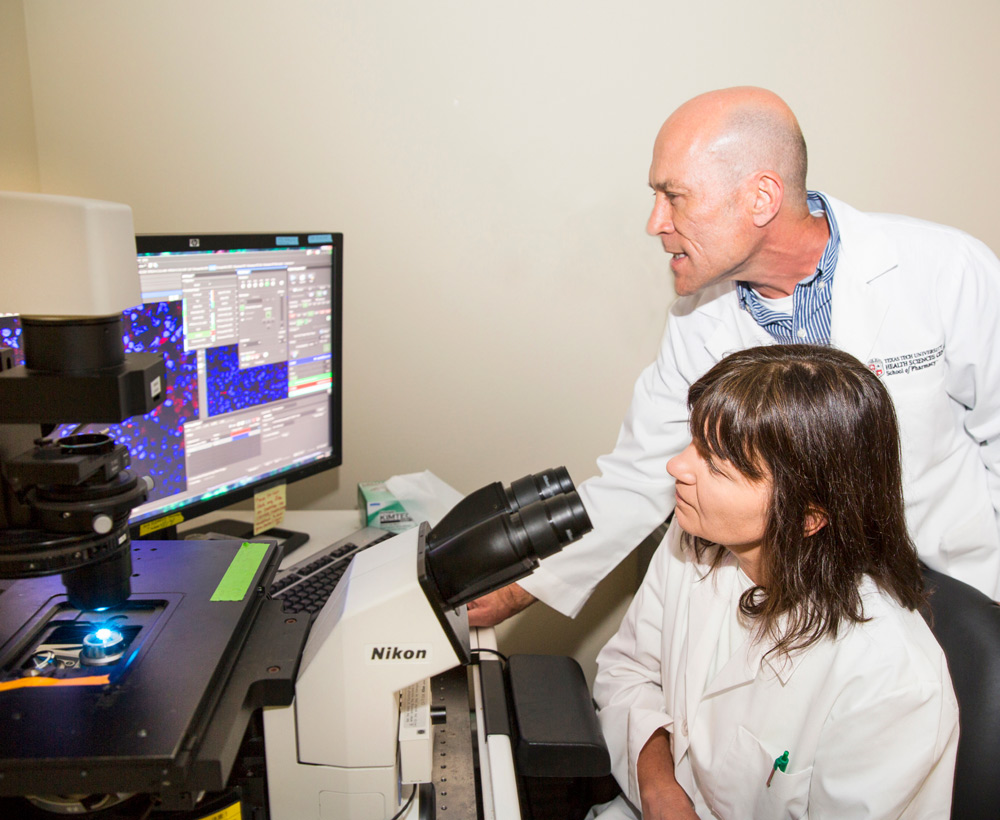
During those years, Magdalena Karbowniczek, MD, PhD, a Szczecin native, enrolled in the same Polish university. A few years later, she joined Markiewski’s department, also as a pathologist.
“We shared a passion about pathology and some science at the beginning, and we also taught students,” Markiewski recalls. “Madga was actually my student, but I didn’t know her until she joined the department.”
In 1997, Markiewski and Karbowniczek married, and though they both were successful in Poland, Markiewski wanted to pursue a scientific career. He accepted a postdoctoral position at the University of Pennsylvania. A few months after their arrival in the U.S., Karbowniczek found work as a postdoctoral researcher at Philadelphia’s Fox Chase Cancer Center.
“We quit everything in Poland to start an entirely new career,” Markiewski said. “We took enormous risks to pursue our dreams here. We were already accomplished doctors in Poland with good reputations, but we decided to come here anyway. My initial salary was $26,000 per year with double doctorate degrees. That is how it started for us in the United States.”
“We came to Abilene and they liked us; they also liked us as scientists, so we got two positions,” Markiewski says. “In addition, we fell in love with the people in Abilene, which perhaps was a strong factor in motivating us to accept jobs here. This is how we started to collaborate, because our labs were basically one lab.”
Markiewski, who has been in Abilene since 2010, has established himself as an immunologist specializing in cancer immunotherapy and the biology of innate immunity (the body’s first barrier against disease and infection). He has received grants from agencies such as the NCI, NIH and U.S. Department of Defense.
Karbowniczek, also in Abilene since 2010, has established her own reputation as a cancer biologist with expertise in basic molecular mechanisms that regulate the transformation of normal cells into malignant tumor cells. One of her projects, currently supported by a NIH grant, is investigating a pulmonary disease called LAM (lymphangioleiomyomatosis), which occurs exclusively in women.
One of their current collaborative efforts, a research publication they recently submitted to “Communications Biology,” a peer-reviewed scientific journal, included their 18-year-old son, Jan Markiewski, a computer programming and data analysis learner. Jan, who completed an internship at Harvard Medical School, recently returned to Abilene after an exchange program in Germany. He contributed his computer and data analysis expertise to that publication.
“Our entire family is now in the science business,” Markiewski says. “Jan is very invested in this, and he can do a lot with computer programming and data analysis, so like with me and Magda, our expertise synergizes. We always have each other’s support, which I think is the key to getting through any struggles and problems at home and at work.”
—By Mark Hendricks
Magdalena Karbowniczek, MD, PhD Education:
Publications, speaking events, patents and awards:
- Publications: 32
- Invited Speaking Events: 4
- Patents: 1
- Awards: 13
Maciej Markiewski, MD, PhD Education:
Publications, speaking events, patents and awards:
- Publications: 71
- Invited Speaking Events: 16
- Patents: 5
- Awards: 7