

Honoring Her First Patient




“Sometimes she’d be so sick that she couldn’t get out of bed,” recalls Hobart, who got a job at 13 to buy a family car and help pay the bills. “I’d organize her medications, make sure she got to her appointments and try to spot signs of worsening sickness before it got out of hand.”
Hobart remembers her mom’s physician for his compassion and commitment to building relationships with his patients. He empathetically walked mother and daughter through their struggles, “and what a difference that relationship made,” Hobart says. She didn’t know it then, but those experiences would shape her future career aspirations.
Years later, Hobart, the first in her family to go to college, pursued a humanities degree at Texas Tech University. She recalls reading the tagline for the degree program, “Interested in physics and photography?” which described her unclear aspirations perfectly. She had never dreamed of a future outside of caring for her mother, but her older brother ensured that she would be able to pursue college and any other opportunity she desired.
As an undergraduate, she stumbled on the Dr. Bernard Harris Pre-Medical Society at Texas Tech. Hobart attended a few meetings and began to envision herself as a doctor. There was only one problem: She didn’t know how to make it happen. She took the idea to her brother, 13 years her senior, who promptly called TTUHSC for guidance.
“It was hilarious how clueless we were,” Hobart recalls. “We didn’t even know that you had to complete your bachelor’s degree before going to medical school. The helpful admissions person kindly suggested we call back in a couple of years.”
Hobart continued to attend medical society meetings and then was accepted to the Joint Admission Medical Program (JAMP), an undergraduate pipeline program created by the Texas legislature to help economically disadvantaged Texans pursue their dreams of becoming a doctor. The program provides financial and academic support as students prepare for admission to any of 13 Texas medical schools.
“I had spent so much of my life in survival mode, I’d never projected into the future,” she says. “I was so blessed to be accepted into the JAMP program and eventually to the TTUHSC School of Medicine.”
Serendipitously, during her first year of medical school in 2010, TTUHSC launched the Family Medicine Accelerated Track (FMAT) program. Earning a medical degree typically takes four years, but the novel three-year MD curriculum is designed to fast-track students into family medicine in underserved regions of West Texas and beyond through patient-centered education.
“When I read about the FMAT program, I realized it represented everything I had envisioned about being a doctor,” she says. “I was like, ‘sign me up!’ I couldn’t wait to begin building the type of patient-physician relationships that had shaped my family and to get to do it sooner rather than later.”
Today, Hobart, a Lubbock native, is a family medicine physician and associate professor of medicine at TTUHSC Lubbock School of Medicine, where she also is co-director of the FMAT program and director of the Family Medicine Clerkship for all students. The FMAT clerkship gives second-year students the opportunity to take part in outpatient clinic experiences and inpatient hospital service one year sooner than their peers in the conventional curriculum.
“In the beginning, our students sometimes had to explain why they were on clinical teams earlier than usual,” Betsy Jones, EdD, professor and chair of the School of Medicine Department of Medical Education, and FMAT co-director, says. “Now, FMAT is a respected and understood pathway. Our residents, many of whom were FMAT students themselves, mentor the new ones.
“Our students are seeing patients at the same time that they’re still learning about organ systems, pathophysiology, multisystem disorders and cancer,” Jones says. “It allows them to process, understand and apply their preclinical basic science curriculum better. That’s really one of the strengths of the FMAT program.”
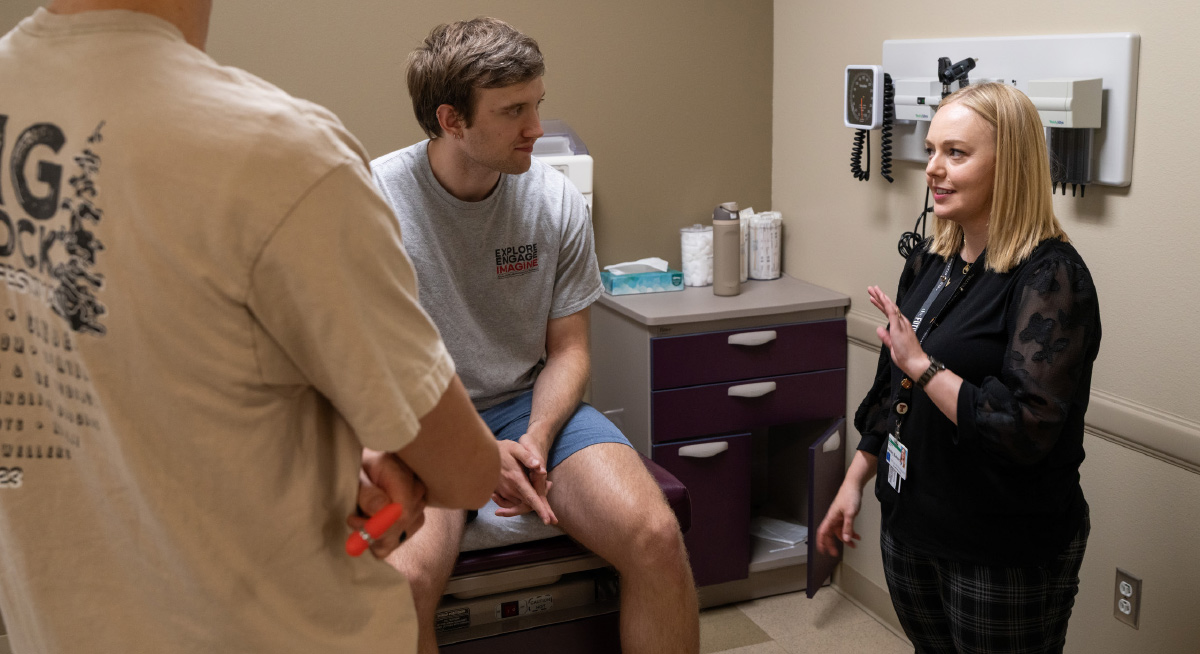
In May, seven more students graduated and joined the physician ranks, bringing the total to 103 since FMAT’s inception. The three-year program was the first of its kind in the country, drawing national media attention when it was launched. As an FMAT student, Hobart was interviewed by “NBC Nightly News” for a story highlighting the program’s groundbreaking role.
Since then, 40 medical schools have created their own three-year accelerated MD programs, Jones says.
Hobart, who in 2022 was listed in Texas Monthly as a “Super Doctor Rising Star,” is emblematic of program graduates, Jones says. “She’s a great, intuitive teacher. She experienced great teaching and has a really intuitive sense of what a learner needs and how to provide clinical connections.”
FMAT is having a profound impact. According to Hobart, roughly 65% of program graduates have gone on to serve in rural or underserved areas. Some of her patients drive hours from New Mexico to see her.
“What we’re doing here is working,” says Hobart, a mother of two and wife of Chris Hobart, PharmD, (TTUHSC Pharmacy ’14), who owns and operates Lubbock’s Highland Pharmacy. “We’re training doctors who really understand the communities they serve.”
The Hobarts are now spicing things up with non-medical pursuits as well. In January, the couple and family members acquired Outlaw Egg Rolls, a Lubbock food truck known for its novel twists on Asian favorites. “The Italian” egg roll, anyone? Hobart, ever the doctor, decided that unmarked egg rolls were too dangerous for people with life-threatening food allergies. She ended the egg roll roulette by hand stenciling logos onto each roll with an edible marker — an idea she counts among her greatest.
But it’s her day job, and the memory of her mom, who died in 2020, that guides her days.
“My mom was my first patient,” Hobart says. “She taught me that sometimes there’s not an easy cure or an easy fix, but just being there with the patient on their journey, is therapeutic in itself.”
The Backstory
In conventional MD training, the fourth year serves primarily as an “audition” period for residency placement and a time to finalize specialty decisions, Betsy Goebel Jones, EdD, professor and chair of the School of Medicine Department of Medical Education, and FMAT co-director, says. FMAT students declare their family medicine intent early – often upon admission or during their first year – streamlining their medical education.
FMAT graduates are guaranteed a residency at one of four partner hospitals in Amarillo, Lubbock and Odessa.
“We’re not trying to produce more doctors faster,” Jones adds. “We’re trying to produce the right doctors—those who want to serve in areas where the need is great, and who are willing to make that commitment early.”